
TV Mounting Coast Huntington Beach: TV Wall Mounting in Huntington Beach
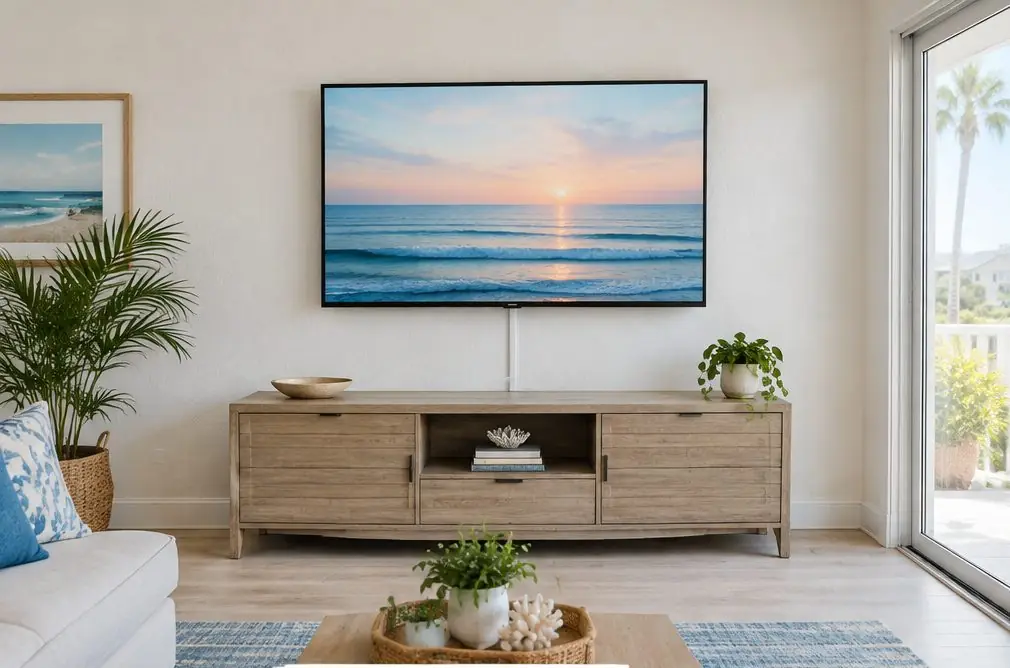
TV Mounting Coast Huntington Beach covers everyday TV wall mounting across Huntington Beach — living rooms in 1960s and 1970s tract homes, bedrooms in newer two-stories, family rooms in Seacliff and the southeast — where a local installer finds the studs, hangs a fixed or tilting bracket, sets the screen to the seating and leaves the cords tidy.
Bookings aren't open yet. Leave your name and number; your message is recorded, and you'll get one message when a local installer is available.
 Illustration
A standard Huntington Beach install, step by step
- The TV's weight and VESA pattern are matched to a bracket rated at least 1.5 times the weight.
- Studs are found with a stud finder and confirmed with a small probe hole behind the plate's footprint.
- Painter's tape marks the TV's outline; it is checked from the sofa before drilling.
- Pilot holes go into the stud centers and 5/16 in lag bolts pull the plate tight to the wall.
- The TV's arms are attached, the screen hooks on, and the locking screws are set.
- Level is checked again with the weight on, and the cords are bundled to the outlet.
| Bracket | Gap to wall | Moves after install | Typical use |
|---|---|---|---|
| Fixed (flat) | About 1–1.5 in | No | Screen at eye level facing the sofa |
| Tilting | About 2–3 in | Tilts down 5–15° | Bedroom walls, above a dresser, window glare |
| Fixed with extra depth | About 2–3 in | No | Clears thick baseboards or an outlet box |
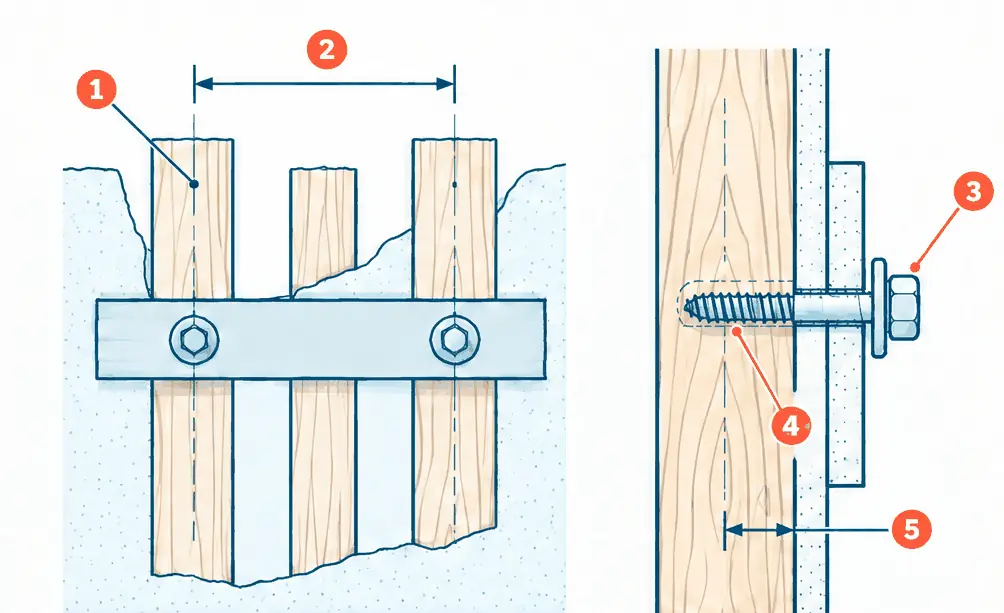
What the numbers show
- Stud centre line Each bolt lands on the centre of a stud, found with a stud finder and confirmed with a small test hole.
- Stud spacing Studs usually sit 16 inches apart, centre to centre, sometimes 24; slots in the plate let the bolts reach two of them.
- Washer and head A washer spreads the clamping force on the plate; the bolt is tightened snug, not stripped.
- Threads in solid wood The threads bite into the stud, not the drywall; a pilot hole keeps the wood from splitting.
- Depth into the stud The threads reach deep enough into the wood for the mount maker's rating.
What the 1960s and 1970s tract homes look like inside
Most single-story and two-story homes built across Huntington Beach in the 1960s and 1970s have drywall over wood studs at 16 inches, often with a textured finish and a long living-room wall that faces a sliding door. Studs are rarely where the TV should be centered, so the bracket's wide plate is used to reach two studs while keeping the screen centered on the wall or the console.
Height and the coastal living room
Many Huntington Beach living rooms are bright, with sliders and windows facing the patio, and low sofas. For seated viewing the screen center usually lands around 42 inches from the floor; across from a bright slider a tilting bracket cuts the glare. Bedrooms take a higher placement and more tilt.
A good wall mount is one nobody notices — the screen is just where the eyes already are.
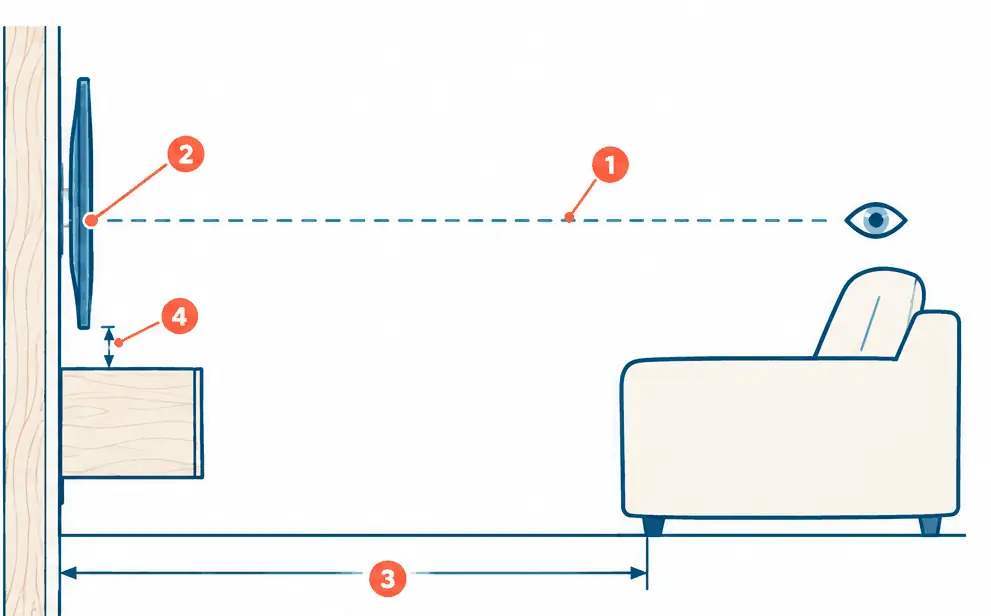
What the numbers show
- Seated eye line Eye level on a typical sofa is a little over three feet from the floor; it is measured from the actual seat.
- Screen centre The centre of the screen sits close to the seated eye line, so the head stays level while watching.
- Viewing distance Distance from the seat to the screen affects the comfortable screen size and how much height the eye forgives.
- Console gap The floating console sits below with room for the soundbar and cables, without pushing the TV too high.
Leaving it finished
Cords are bundled and run straight down to the outlet or covered with a short paintable channel. The mount's locking screws are tightened so the TV cannot be lifted off from below. The leftover hardware and the manual stay with the household.
When no stud lines up
Sometimes the spot where the TV belongs is hollow drywall between studs — a wall centered on a window, a fireplace offset, or studs placed at odd spacing during an old remodel. The rule stays the same: studs are used wherever they line up with the plate, and anchors only fill the gaps.
- Strap toggle — a metal channel folds through a small hole, then turns flat and bears on the back of the drywall across a wide area; a plastic strap pulls it tight and a machine bolt holds the plate.
- Rating check — the TV's weight plus the mount's weight is compared with the anchor's rated load in that drywall thickness, with a generous margin, before any anchor is chosen.
- Mixed fixing — one side of the plate in a stud with lag bolts, the other on strap toggles, is common when only one stud falls under the plate.
- No anchors for arms — full-motion arms and very large TVs go into studs or onto a backer board, not onto drywall anchors alone.
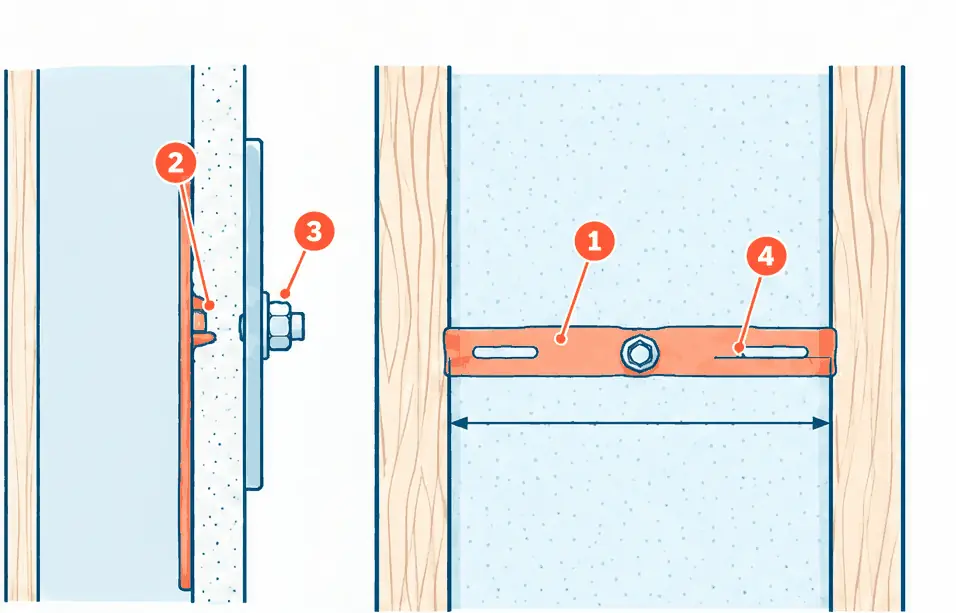
What the numbers show
- Steel channel The channel goes through the hole folded, then turns and is pulled flat against the back of the drywall.
- Plastic straps The straps hold the channel in place while the bolt is started, then are snapped off flush with the wall.
- Machine bolt The bolt passes through the wall plate and threads into the channel; tightening clamps plate, drywall and channel together.
- Spread load The channel bears across a wide strip of drywall; the TV's weight is still checked against the anchor's rating, and studs are used wherever they line up.
TV Wall Mounting — common questions
How much does a basic TV wall mount cost in Huntington Beach?
About $109–$149 for a 32–49 inch TV and $129–$179 for 50–65 inches on drywall over wood studs in 2026; larger TVs and harder walls add to that.
Does the installer bring the bracket?
Either works. A supplied bracket adds $45–$140 by type and size; one the homeowner already bought is checked against the TV's weight first.
TV Wall Mounting: check availability and price range
Bookings aren't open yet — tap what fits your TV and wall and get a typical Huntington Beach price range right here. Typical Huntington Beach prices for one TV, labor only unless an option says otherwise. This is a market estimate, not a quote.